On this page
CostTypes of pruningNo toppingWhen to pruneEvery situationCouncil rulesHow it worksAreas
How Much Does Tree Pruning Cost in Croydon?
Tree pruning in Croydon typically costs between £200 and £1,500+, depending on the size of the tree, the type of pruning and how easy it is to reach. A light deadwood prune of a small tree is a short job, while a crown reduction on a mature oak in a tight garden needs a full team, rigging and more time.
| Job | Indicative cost |
|---|
| Deadwood removal or light tidy, small tree | £200 – £300 |
| Crown lift, small to medium tree | £200 – £500 |
| Crown thin or reduction, medium tree (3 to 6m) | £250 – £500 |
| Crown reduction, medium large tree (6 to 9m) | £450 – £850 |
| Crown reduction, large mature tree (over 9m) | £800 – £1,500+ |
| Pollarding, per tree | From £380 |
| Several trees in one visit | Reduced price per tree |
These are guide figures. After we've seen the tree, you get a fixed, itemised written quote. Use the cost calculator · Full cost guide →
| What affects the price | Why it matters |
|---|
| Tree size and height | Larger trees take more time, people and equipment |
| Type of pruning | Light deadwood removal costs less than a major crown reduction |
| Number of trees | Several trees in one visit can reduce the cost per tree |
| Access | Tight gardens or trees over buildings need extra care or equipment |
| Waste removal | We take away branches as standard; leaving logs or chip with you can reduce the price |
| Permissions | Protected trees or conservation areas may need an application or notice first, which we prepare for you |
Types of Tree Pruning
Good pruning removes the right branches for a clear reason, such as safety, light, space or tree health.
| Type | What it does | Best for |
|---|
| Crown reduction | Shortens branches back to suitable growth points to reduce height and spread | A tree that has outgrown its space |
| Crown thinning | Removes smaller branches throughout the crown to let in light and air without changing size much | Dense, heavy crowns |
| Crown lifting | Removes lower branches to raise the base of the canopy | Clearance over paths, roads, windows and lawns |
| Deadwood removal | Takes out dead, diseased or damaged branches | Any tree, often combined with other work |
| Pollarding | Cuts the main branches back to a framework, then repeats on a regular cycle | Trees already managed this way, such as street limes and planes |
| Formative pruning | Shapes young trees | Trees with a poor early structure |
| Fruit tree pruning | Shapes and thins for health and crop | Apple, pear, plum and cherry trees in gardens |
How Much Can You Take Off?
As a rule of thumb, take no more than around a quarter to a third of a tree's live crown in one go. Heavy cuts stress the tree and can trigger weak, fast regrowth. Where a tree needs more than that, we'll recommend staged pruning over a few years, or tell you honestly that removal is the better answer. See tree removal.
Why We Don't Top Trees
Topping means cutting branches back to stubs. Arboriculture bodies, including the International Society of Arboriculture, warn that it can starve the tree, invite decay and produce weak regrowth that is more likely to break. If a tree is too big we use crown reduction instead, working to current British Standard tree work recommendations (BS 3998). Be wary of anyone who offers to "top it" cheaply.
When to Prune a Tree
For most deciduous trees the dormant season, roughly November to February, is a good time. Timing depends on the species.
| Tree or situation | Usual timing |
|---|
| Most deciduous trees (oak, lime, sycamore, beech) | Dormant season, roughly November to February |
| Cherry, plum and other Prunus | Light pruning in spring or summer, not winter (silver leaf risk) |
| Birch and other bleeding trees | Late summer or early autumn |
| Apple and pear | Winter, with a light summer tidy |
| Horse chestnut | Winter; watch for bleeding canker and get advice if bark is oozing |
| Ash | Take advice first; ash dieback can make branches brittle. Ash dieback guide → |
| Dead, damaged or dangerous branches | Any time |
| Any tree in nesting season | Avoid March to August where possible |
Oak processionary moth. This pest is established across parts of London. Its caterpillar nests and hairs can irritate skin and airways, so don't touch them. If you think your oak is affected, report it to the Forestry Commission or Croydon Council and tell us before any work.
Tree Pruning for Every Situation
Tree Touching or Overhanging Your Roof
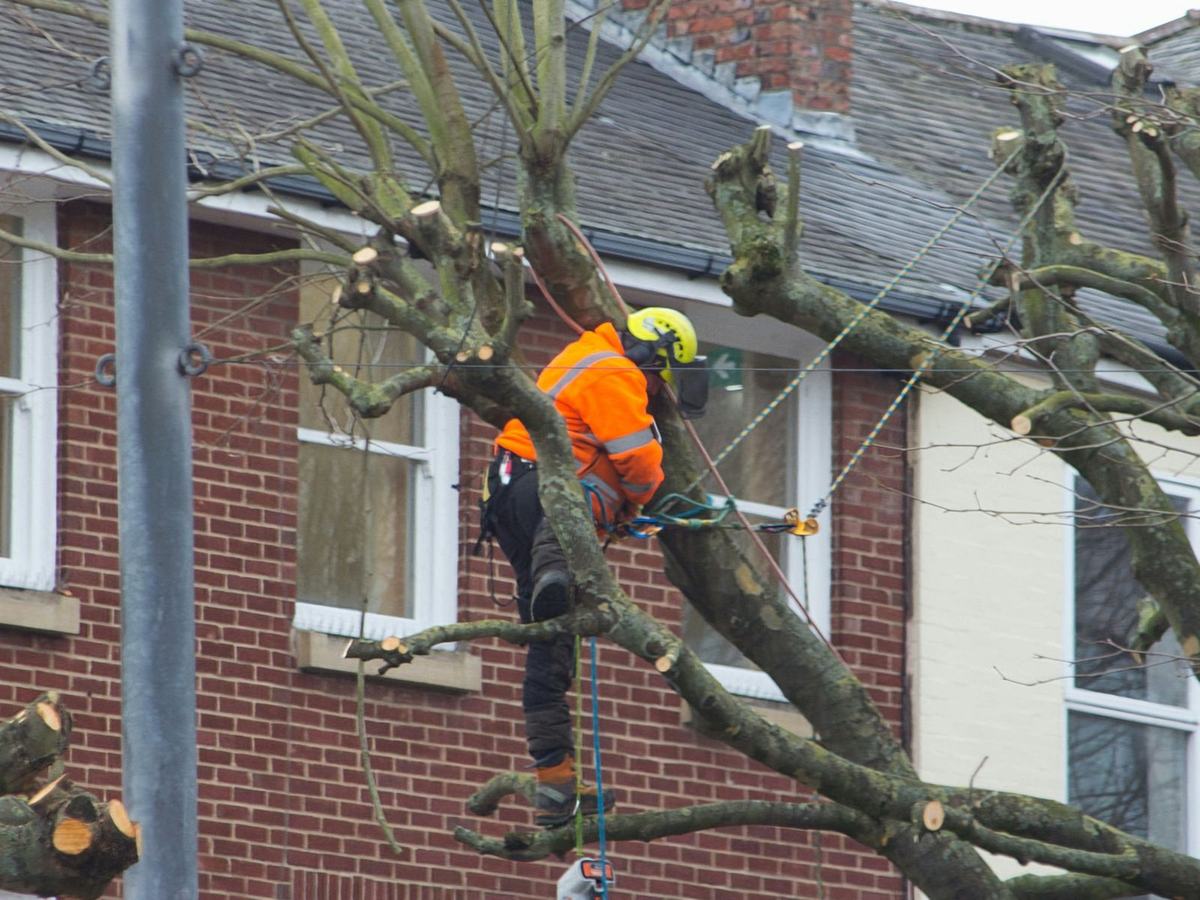
Branches on a roof drop leaves, clog gutters and can damage tiles. We lift or reduce the crown to give a safe gap, usually enough that branches can't scrape in wind. Where a tree sits very close to the house, see trees near buildings.
Tree Blocking Light
If a tree is shading your windows or garden, crown thinning lets light through without changing the tree's shape much, and crown reduction cuts its size. For an evergreen hedge blocking your light, see hedge cutting.
Overhanging Branches Over a Pavement or Road
If branches overhang a public pavement or road, the owner is responsible for keeping them clear, and the council can require it under the Highways Act 1980. Councils commonly work to clearances of around 2.5m over a pavement and 5.5m over a carriageway. A crown lift is the usual fix.
Branches Near Power Lines
Never cut near overhead cables yourself. Branches on or near power lines need specialist handling and, in London, usually coordination with the network operator, UK Power Networks. If a branch has brought down a line, stay well clear and call 105.
Your Neighbour's Overhanging Branches
Where branches overhang your property you may have a common law right to cut them back to the boundary, but not beyond it. Talk to your neighbour first, offer the cuttings back, and check the tree isn't protected or in a conservation area. If the tree is protected, you can't cut it without consent, even on your side of the fence.
Storm-Damaged Branches
Split or hanging branches need making safe quickly. See emergency tree work.
Fruit Trees and Garden Trees
We prune garden apple, pear, plum and cherry trees for health, shape and crop, timed to the species. We can also reshape neglected or overgrown trees over a few seasons.
Landlords, Letting Agents and Commercial Sites
For rental properties, blocks and commercial sites, we can combine pruning with a tree survey and a written quote to pass to the owner or managing agent.
Can You Prune Your Tree? Croydon Council Rules
Check Protection First
Croydon Council says a tree preservation order (TPO) stops visually important trees being removed or pruned without formal permission, and that you must give six weeks' written notice before work to a tree in a conservation area. In a conservation area this applies to trees with a trunk over 75mm in diameter, measured 1.5m above ground. Fines of up to £20,000 can follow for cutting down a protected tree without permission, and up to £2,500 for pruning one. We check both before any work. TPO guide and conservation area guide.
| Situation | What you must do | Risk if you don't |
|---|
| Tree has a TPO | Apply to Croydon Council for consent, stating exactly what pruning you want | Fine up to £2,500 for pruning, up to £20,000 for felling |
| Tree in a conservation area | Give six weeks' written notice (trunk over 75mm at 1.5m) | Same offences as a TPO |
| Dead or dangerous branches | Only urgent works without consent; five days' notice is asked for | Keep photographic evidence |
| Unprotected tree, outside a conservation area | Generally no permission needed | Still check for nests and bats |
We handle the paperwork. A TPO application or conservation area notice needs a precise description, such as "crown lift to 4m" or "reduce by up to 2m". Vague wording can get an application refused. We prepare and submit it for you.
Nesting Birds and Bats
Wild birds and their active nests are protected, and the main nesting season generally runs from March to August. It's an offence to intentionally damage or destroy a nest that is in use or being built. Many trees also host bats, which are protected. We check before we cut, and an active nest can mean part of the work waits. Nesting season guide.
How Tree Pruning Works
- Tell us about it. Call us or use the quote form, with photos and your postcode.
- Site visit and quote. We look at the tree and send an itemised written quote.
- Protection and wildlife checks. We check tree preservation orders, conservation areas, nests and bats first.
- Plan. We agree the date, method, where vehicles go and what to move.
- The work. Our qualified, insured team prunes to the agreed specification and protects your property and your neighbours'.
- Clean-up. We clear all branches and leave the area tidy. See our services page for how clean-up and recycling work.
Tree Pruning Across Croydon
We carry out tree pruning across the borough, including Addiscombe, Shirley, Thornton Heath, Norbury, Crystal Palace and Upper Norwood, South Croydon, Selsdon, Sanderstead, Purley, Coulsdon and Kenley (CR0, CR2, CR5, CR7, CR8, SE19 and SW16).