On this page
Common problemsCostOver roofs and conservatoriesHow we work safelyRoots and subsidenceDrains and pathsHow close is too close?Extensions and building workOverhead cablesPermission and neighbours
Common Problems With Trees Near Buildings
| Problem | What can be done | Who else may need to be involved |
|---|
| Branches over the roof or touching the house | Prune or reduce the crown, or remove the branches or tree | A roofer, if the roof is damaged |
| Tree over a conservatory or glass roof | Remove or reduce with controlled sectional work, protecting the structure | Your installer or insurer, if there is damage |
| Tree over a garage, shed or outbuilding | Reduce or remove with rigging so nothing lands on the structure | Your insurer, if there is damage |
| Tree leaning towards the house, or newly leaning after a storm | Assess it and make it safe; a survey can assess condition | Emergency services if there is immediate danger; the council if protected |
| Branches or leaves blocking gutters | Prune back from roofs and gutters | A gutter or drainage contractor |
| Sticky sap or honeydew on glass, cars or patios | Crown thinning or lifting can reduce it; sometimes removal | None |
| Roots lifting a path, drive or wall | Assess the tree and advise on its size and condition | An arboriculturist or landscaper for root options |
| Cracks in walls or floors near a tree | Report on the tree's condition and size | A structural engineer and your insurer, who can say what is causing the cracks |
| Tree close to a planned extension or new build | Survey, advice and protection or removal plans | Your architect, builder and building control |
How Much Does Tree Work Near a Building Cost?
Work beside or over a building usually takes more time, people and equipment than the same work in open space, because pieces must be controlled rather than dropped. Expect to pay more than for the equivalent job in an open garden, often 10% to 30% more.
| Job | Indicative cost |
|---|
| Crown lift or reduction, branches over a roof | £220 – £650 |
| Removal of a small or medium tree close to a house | £280 – £780 |
| Removal of a large tree over a house or conservatory (sectional, rigged) | £1,100 – £3,900+ |
| Crane or platform hire (where needed) | Added to the quote |
| Tree report for an insurer or engineer | See tree surveys |
These are guide figures. After we've seen the site, you get a fixed, itemised written quote. See the cost guide.
| What affects the price | Why it matters |
|---|
| Method needed | Sectional dismantling and rigging take longer than felling whole |
| Crane or platform | Needed for some large trees or sites with no safe drop zone |
| Size and height | Bigger trees need more people, time and equipment |
| What is below and beside the tree | Roofs, glass, cables and neighbours slow the work |
| Access | Narrow gates, no side access or no space for vehicles add time |
| Permissions | Protected trees or conservation areas may need an application or notice first |
Trees Over Roofs, Conservatories and Garages
Tree Over a Roof
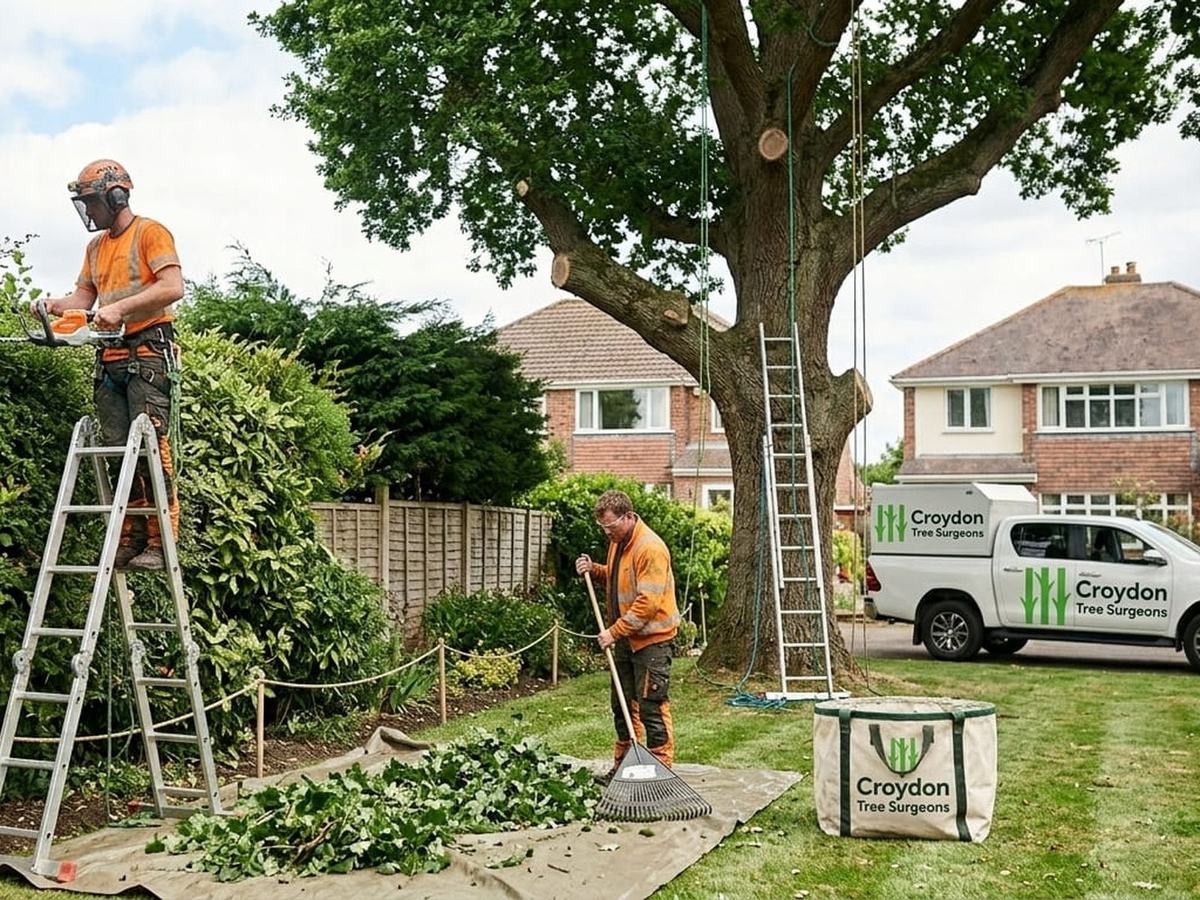
Branches resting on or scraping a roof wear tiles, clog gutters and drop leaves and debris. In strong wind, a branch that is only brushing the roof can snap and land on it. We usually lift or reduce the crown to leave a safe gap, and where a tree is too large for its position we'll tell you honestly if removal is the better answer.
Tree Over a Conservatory or Glass Roof
Glass and polycarbonate roofs are the most vulnerable part of a house. A falling branch can break them, and the tree also drops sap, honeydew and debris that stain and clog. We plan these jobs carefully, using sectional dismantling with ropes and rigging, so no piece drops onto the structure.
Leaning Trees
Some trees lean from the day they grew, and many are perfectly stable. A new lean, or a lean combined with soil heaving, cracked ground or exposed roots at the base, can mean the roots are failing. Keep clear and call us. See emergency tree work.
How Work Near Buildings Is Done
| Method | When it is used |
|---|
| Straight felling | Where there is clear space for the tree to fall safely |
| Sectional dismantling | Too close to a building to fell whole; a climber lowers each section under control |
| Rigging and lowering | Heavier sections lowered on ropes to a safe landing area |
| Platform or crane | Large trees, or no safe drop zone, where available |
| Pruning instead of removal | Where reducing or lifting the crown solves the problem |
Before starting, we assess where pieces can safely go, what is below and beside the tree (roofs, glass, walls, cables, neighbours' property) and how people and equipment will get in. We'll tell you what to move in advance (cars, garden furniture, anything fragile) and agree the plan with you before any cut.
Tree Roots, Subsidence and Heave
A tree surgeon can tell you about the tree: its species, size, condition and how close it stands. We can't tell you why a wall is cracking or a drain is blocked. That takes an engineer, your insurer or a drainage specialist.
Please do not remove a tree you suspect of affecting your building before you have taken advice, and never assume that removing a tree will fix subsidence.
How Trees Can Affect Buildings
On shrinkable clay soils, tree roots draw water from the ground. In a dry summer the soil can shrink, and a building with shallow foundations can move as the ground drops beneath it. This is subsidence. If a large tree on clay is removed, the soil slowly takes water back up and swells, which can lift the building. This is heave, and it can continue for several years.
Broadly, the north of the borough (Norbury, Thornton Heath, Upper Norwood and Crystal Palace) sits on clay soil that shrinks in dry weather, while the southern hills (Purley, Kenley, Coulsdon, Sanderstead and Selsdon) sit on chalk. Older homes, such as Victorian and Edwardian terraces, usually have shallower foundations than modern ones.
Signs of Possible Subsidence
| What you see | What it may mean |
|---|
| Diagonal cracks, often from the corners of doors and windows, wider at the top | Typical subsidence pattern |
| Cracks that open wider in late summer and autumn, and close in winter | Seasonal movement linked to the soil drying out |
| Doors and windows sticking, or gaps opening at the corners of rooms | Frame distortion |
| Cracks between an extension and the main house | Differential movement |
| Hairline cracks in plaster or paint | Often just normal settlement or drying out, not subsidence |
| Cracks that appeared suddenly or widen quickly | Get advice quickly |
Only a structural engineer can say what's causing cracks. Trees with a high water demand are most often involved, notably oak, poplar, willow and elm, especially when large and close to the building.
What Happens If You Suspect a Tree
- Don't remove or hard-prune the tree yet. This can make things worse, and if the tree is protected it may be illegal.
- Tell your buildings insurer. Many policies cover subsidence, usually with an excess.
- The insurer typically appoints a loss adjuster and engineers, who investigate cracks, foundations, soil and roots, often with monitoring over several months.
- A tree report records the tree's species, size, distance and condition and recommends what tree work, if any, is needed. We can provide it. See tree surveys.
- If the evidence points to the tree, the insurer's report usually recommends the tree work. For a protected tree, the application to Croydon Council should include the engineer's and arboricultural evidence.
- We carry out the agreed work exactly as specified, and clear up.
Roots, Drains, Paths and Walls
| Problem | What to know |
|---|
| Blocked or slow drains | Roots often enter old pipes through existing cracks or joints. A CCTV drain survey will show what's happening |
| Responsibility | You are generally responsible for your own private drain up to your boundary, while lateral drains and sewers belong to the sewerage company |
| Roots lifting a path, drive, patio or wall | Don't cut large roots yourself, as it can destabilise or kill the tree. Options include flexible or bridged surfacing and reducing the tree |
| Garden walls and boundaries | Large trees tight against a boundary wall can cause movement over time. If a wall is shared, agree any work with your neighbour first |
How Close Is Too Close?
There's no single legal distance between a tree and a house. What matters is the species, size, soil and foundations.
| Situation | Rule of thumb |
|---|
| Existing tree, no damage or signs of movement | Usually fine; monitor it and keep it in proportion with pruning |
| High water-demand tree on clay, within about its mature height of the house | Higher risk; a survey is worth having |
| Planting a new tree on clay | Keep high water-demand species well away, at roughly their mature height or more; smaller trees can go closer |
| Building or extending near an existing tree | Foundations may need to be deeper; get advice from building control and an arboriculturist |
If you're choosing a new tree, ask us before you plant. A small ornamental tree in the right place can be a better choice than a forest-sized one that will cause problems in 30 years.
Trees and Extensions, Driveways and Building Work
Planning an extension, garage, driveway or garden building near a tree? Check before you design:
- Is the tree protected? A TPO or conservation area affects both the tree and the build. Planning permission doesn't automatically override a TPO.
- How big is the root protection area? Under BS 5837 the radius is roughly 12 times the trunk diameter, measured 1.5m above ground, up to 15m. A 60cm trunk gives about 7.2m, which can reach well into your plot.
- Foundation depth. Building near trees on clay may need deeper foundations. Your architect and building control will advise.
We can provide a tree report to pass to your architect, builder or the council. See tree surveys.
Trees Near Overhead Cables
Never work near overhead power lines yourself. Trees close to or touching electricity lines need specialist handling and, in London, usually coordination with the network operator, UK Power Networks. For telephone and broadband lines, the line owner should be contacted. If a tree has brought down a line, stay well clear and call 105. Tell us about any cables when you request your quote so we can plan the right method.
Permission and Neighbours
Check Protection First
Croydon Council says a tree preservation order (TPO) stops visually important trees being removed or pruned without formal permission, and that you must give six weeks' written notice before work to a tree in a conservation area. Fines of up to £20,000 can follow for cutting down a protected tree without permission, and up to £2,500 for pruning one. We check both before any work. TPO guide and conservation area guide.
An engineer's recommendation to remove a tree doesn't remove the need for consent if the tree is protected.
Whose Tree Is It?
A tree belongs to the owner of the land where its trunk grows, and a boundary tree may be jointly owned. We can only work on a tree with its owner's consent, and will not enter a neighbour's land without permission. If a neighbour's tree is damaging your property, talk to them first and keep photos. If the tree is on council land or the highway, report it to the council.
Who to Call: Quick Reference
| Your concern | Who to contact |
|---|
| Overhanging or leaning tree, branches on the roof | Us |
| Tree failing or fallen on the house | 999 if anyone is in danger, then emergency tree work |
| Cracks in walls or floors | Your buildings insurer and a structural engineer; we can report on the tree |
| Blocked or damaged drain | A drainage specialist, or your sewerage company for shared and public sewers |
| Roots lifting paving | Us for the tree; a landscaper for the surfacing |
| Tree near overhead lines | UK Power Networks; never attempt it yourself |
| Council or street tree | Croydon Council |
Tree Work Near Buildings Across Croydon
We carry out tree work near buildings across the borough, including Addiscombe, Shirley, Thornton Heath, Norbury, Crystal Palace and Upper Norwood, South Croydon, Selsdon, Sanderstead, Purley, Coulsdon and Kenley (CR0, CR2, CR5, CR7, CR8, SE19 and SW16).