On this page
What removal involvesEvery situationIs your tree protected?Nests and batsWhat affects the priceHow the job worksAfter the tree is gone
What Tree Removal Involves
Tree removal means cutting a tree down and clearing it from your property. How we do it depends on the tree's size and condition and on what is around it. In many Croydon gardens space is tight, so we plan the job before the first cut.
| Method | When we use it |
|---|
| Straight felling | There's clear space for the tree to fall safely |
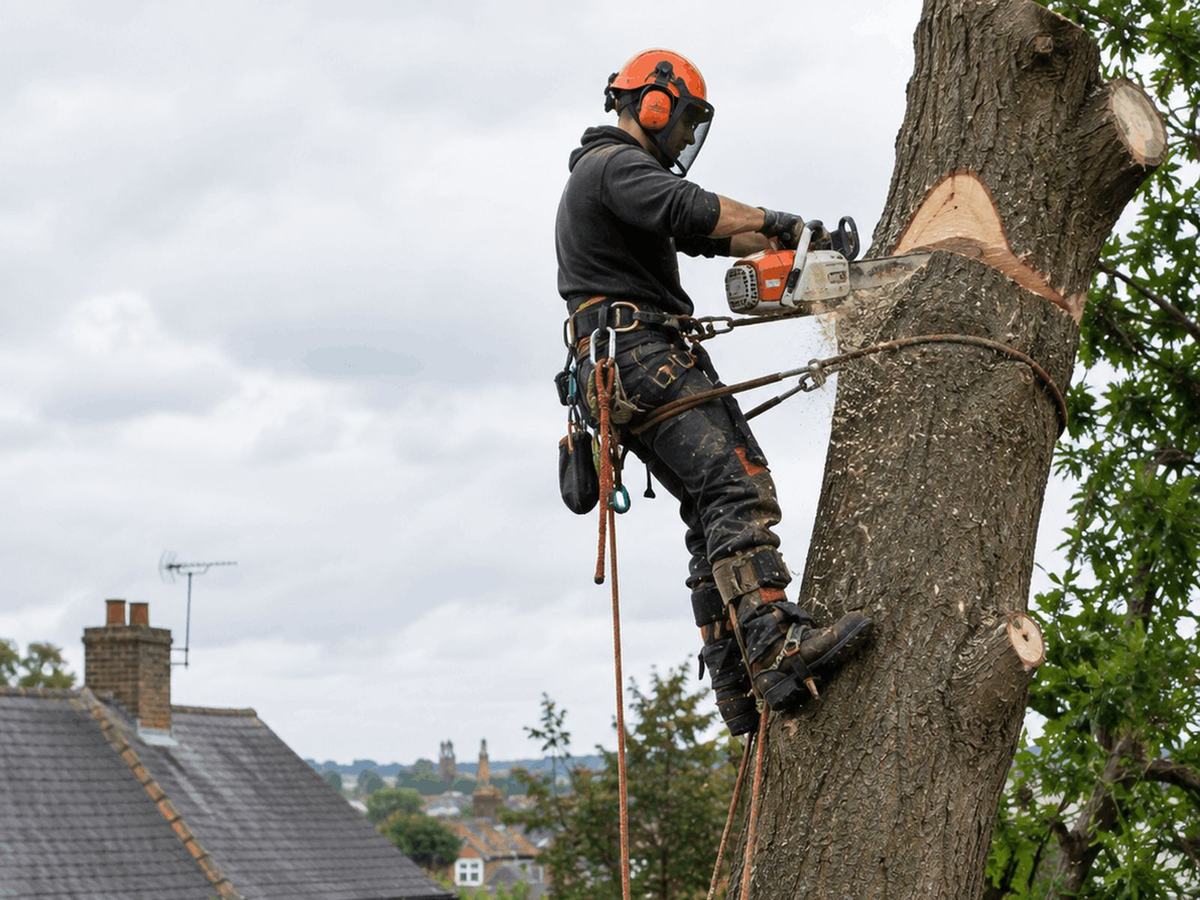
| Sectional dismantling | Houses, fences, cables or neighbouring trees leave no room. A climber takes the tree down from the top and lowers each piece under control |
| Rigging and lowering | Heavier sections are lowered on ropes to a safe landing area |
| Platform or crane | Large trees, or no safe drop zone |
| Pruning instead | Reducing or lifting the crown solves the problem |
Felling a tree whole is generally quicker and cheaper where space allows. We use sectional work when the surroundings don't leave that option.
When Removal Is the Right Answer
- The tree is dead, dying or diseased
- It is dangerous or damaged, for example after a storm
- It is too close to a building, drain or boundary for pruning to manage
- It blocks planned building work or access
- It is the wrong tree in the wrong place and you want a replacement
Removal isn't always necessary. If pruning would solve the problem, we'll tell you. See tree pruning or book a tree survey first.
Tree Removal for Every Situation
Large Tree Removal in a Small Garden
Most Croydon gardens, especially the terraces around Thornton Heath, Norbury and Addiscombe, have no space to fell a tree whole. Our climbers take the tree down from the top in controlled sections, lowering each piece on ropes, so your fences, patio and neighbours' gardens stay untouched. Sectional work takes longer than straight felling, which is why access drives the price.
Dead Tree Removal
A dead tree is brittle and can drop branches without warning, so it should be taken down by a qualified climber and never as a DIY job. Croydon Council's guidance is that a dead tree needs no formal permission, but five days' notice is asked for work to a dead or dangerous tree, and it's wise to keep photographs as evidence. Ash dieback is a growing cause of dead and failing trees locally: ash dieback guide →
Leylandii and Conifer Removal
Leylandii grow fast and often end up far too tall and dense for a garden. Cutting them back hard usually leaves bare brown wood that doesn't regrow, which is why removal is often the better option. Conifers don't resprout from a cut stump, so grinding is usually optional. If it's a neighbour's hedge blocking your light, see our hedge cutting page for the High Hedges route.
Tree Removal Near Power Lines
Never work near overhead cables yourself. Trees close to or touching power lines need specialist handling and, in London, usually coordination with the network operator, UK Power Networks. If a tree has brought down a line, stay well clear and call 105. Tell us about any cables when you request your quote so we can plan the right method.
Trees Over or Close to a House
We remove trees over roofs, conservatories and garages using rigging, so nothing falls onto your property. Removal isn't always the answer. Where a tree is near foundations, taking it out can sometimes cause the soil to swell and do more harm than good. See trees near buildings.
Tree Removal for Subsidence or Root Damage
Broadly, northern Croydon (Norbury, Thornton Heath, Upper Norwood and Crystal Palace) sits on clay soil that shrinks in dry weather, while the southern hills (Purley, Kenley, Coulsdon, Sanderstead and Selsdon) sit on chalk. Clay-soil subsidence claims often involve nearby trees, but don't remove a large tree near a building until your insurer or a structural engineer has advised.
Tree Removal Before an Extension or Building Work
Trees in the way of an extension, driveway or new build often need removing first. Check for TPOs and planning conditions before you plan the build. Planning permission doesn't automatically override a TPO, and an unpermitted removal can hold up the whole project. We check the tree's status and give you a written quote you can pass to your builder or architect.
Your Neighbour's Tree
A tree belongs to the owner of the land where its trunk grows, so you can't have a neighbour's tree removed without their consent. You may cut overhanging branches back to the boundary line (offer the cuttings back, and check for TPO or conservation area status first). If you're sharing a tree or boundary, agree the work and cost in writing.
Landlords, Letting Agents and Commercial Sites
Tree removal at rental properties, blocks and commercial sites needs the freeholder's or owner's permission. We can carry out a tree survey and give a written quote to pass to the owner or managing agent.
Emergency Tree Removal
Trees that have fallen or split after a storm need making safe fast. See emergency tree work.
Is Your Tree Protected? Croydon Council Rules
Check Protection First
Croydon Council says a tree preservation order (TPO) stops visually important trees being removed or pruned without formal permission, and that you must give six weeks' written notice before work to a tree in a conservation area. In a conservation area this applies to trees with a trunk over 75mm in diameter, measured 1.5m above ground. Fines of up to £20,000 can follow for cutting down a protected tree without permission, and up to £2,500 for pruning one. We check both before any work. TPO guide and conservation area guide.
| Situation | What you must do | Risk if you don't |
|---|
| Tree has a TPO | Apply to Croydon Council for consent | Fine up to £20,000 (felling), £2,500 (pruning) |
| Tree in a conservation area | Give six weeks' written notice (trunk over 75mm at 1.5m) | Same offences as a TPO |
| Dead tree | No formal permission; five days' notice asked for | Keep photographic evidence |
| Dying tree | Permission needed | As above |
| Dangerous tree | Only urgent works without consent; give notice | As above |
| Unprotected tree, outside a conservation area | Generally no permission needed | Still check for nests and bats |
Dead, Dying or Dangerous Trees
Croydon Council says a dead tree needs no formal permission, a dying tree does, and for a dangerous tree only the urgent works necessary can be done without consent, with five days' notice asked for work to a dead or dangerous tree. If you're not sure whether your tree is protected, send us the address and we'll check for you, or you can email the council's development management team at development.management@croydon.gov.uk.
Nesting Birds and Bats
Wild birds and their active nests are protected, and the main nesting season generally runs from March to August. It's an offence to intentionally damage or destroy a nest that is in use or being built. Many trees also host bats, which are protected. We check for active nests and signs of bats before felling, and an active nest can mean part of the work waits. Nesting season guide.
What Affects the Price
The cost of removing a tree depends on the job, not just the tree. You get an itemised written quote after we've seen the tree. See the cost guide or try the cost calculator.
| Factor | Why it matters |
|---|
| Tree size and height | Bigger trees need more people, time and equipment |
| Access | Tight gardens, no side access or trees over buildings mean sectional work or a platform or crane |
| Condition of the tree | Dead, diseased or unstable trees can need extra safety measures |
| Location | Trees near buildings, cables, roads or boundaries need more care |
| Waste removal | Taking away timber and branches adds to the job; leaving logs or woodchip can reduce it |
| Stump | Grinding the stump is usually priced separately |
| Permissions | Protected trees may need a council application or notice first |
How the Job Works
- Tell us about it. Call us or use the quote form, with photos and your postcode.
- Site visit and quote. We look at the job and send an itemised written quote.
- Protection and wildlife checks. We check tree preservation orders, conservation areas, nests and bats first.
- Plan. We agree the date, method, where vehicles go and what to move.
- The work. Our qualified, insured team does the job and protects your property and your neighbours'.
- Clean-up. We clear the waste and leave the area tidy.
After the Tree Is Gone
Removing a tree leaves a stump unless it is ground out. Stump grinding takes it below ground level so you can lawn, plant or build over the area. Ask at the quote stage about logs, woodchip and replacement planting. Where permission is granted to fell a protected tree, the council may ask for a replacement.